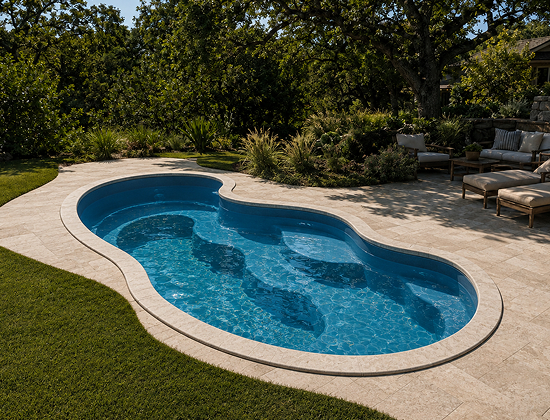
A fiberglass pool is one piece. That single fact drives almost everything else about it — how fast it goes in, how it feels underfoot, how much chlorine it drinks, and why it cannot be reshaped on site. Understanding how the shell is made is the shortest route to understanding what you are buying.
What follows is one shell’s journey: an Alabama 14′×32′, laminated on a Tuesday in July and swimming by the middle of August.
It starts with the mold, not the pool
Before any pool exists there is a mold, and the mold is the expensive part. Each one is built once, polished to a mirror, and then used for years. That is why a manufacturer’s catalogue is a fixed list of shapes rather than a set of options: a new shape means a new mold, not a new drawing.
The mirror finish matters more than it sounds. The mold’s surface becomes the pool’s surface in reverse, so every imperfection in the tool shows up in every shell pulled from it. Molds are inspected and re-polished on a schedule for exactly this reason.

Lamination: built from the inside out
The shell is built in reverse order from how you will experience it. Gel coat is sprayed into the mold first, so the colour you picked from the swatch card is laid against that mirror and becomes the water-facing surface. Only then do the structural layers go on behind it.
The layers, in order
- Gel coat — the pigmented, non-porous surface. Roughly 25 mil, and the only layer you will ever touch.
- Vinyl ester barrier coat — the layer that keeps water out of the structure. Skipping it is where cheap shells develop blisters years later.
- Chopped strand and woven roving — the structure itself, built up in passes and rolled out by hand to drive out air.
- Reinforcement ribs — added at the floor and along the walls, where the shell carries the most load once it is backfilled.
Air is the enemy at this stage. A void left between layers becomes a soft spot, so each pass is rolled by hand rather than left to settle — slow, unglamorous work that decides whether the shell lasts thirty years or fifteen.
What to ask a manufacturer
- Is a vinyl ester barrier coat standard, or an upgrade?
- How thick is the gel coat, and is thickness measured or estimated?
- What is the cure time before a shell leaves the building?
- Is the warranty on the surface, the structure, or both?
Cure time is not padding
Once laminated, the shell has to cure before it can be demolded and moved. Rushing this is the single most common corner cut in the industry, because a shell that leaves early frees the mold for the next one — and the damage does not show up for years.
A shell that cures properly will outlive the house it was installed behind. One that was pulled early will look identical on delivery day and fail in year eight.
— Dave Reinhart, Production Manager
After demolding, the shell is trimmed, the skimmer and return penetrations are cut, and the whole surface is inspected under raking light, which shows up flaws that flat overhead lighting hides completely.
Transport is a design constraint
A finished shell travels on an open trailer, and that puts a hard ceiling on pool size. Anything wider than about sixteen feet needs permits, escorts, and a route planned around bridges and turns. It is the real reason the catalogue thins out above sixteen feet wide, and worth knowing before you fall for the largest model on the page.
| Shell width | Transport | Typical lead time |
|---|---|---|
| Up to 12′ | Standard load | 2–3 weeks |
| 12′ – 16′ | Wide load, no escort | 3–5 weeks |
| Over 16′ | Permits and escort | 5–8 weeks |
Install day
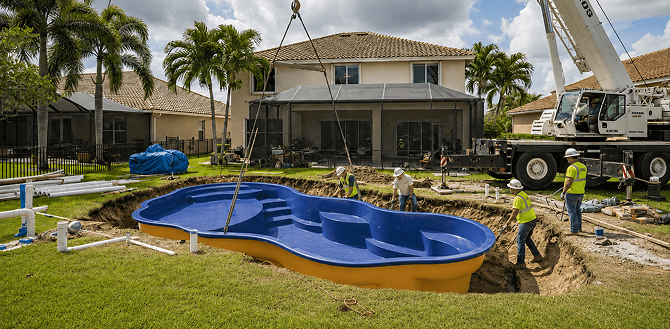
The excavation is dug slightly larger than the shell and bedded with crushed stone, which gives the floor a level, free-draining base. The shell is then craned in — usually the shortest part of the whole process, and the part everyone films.
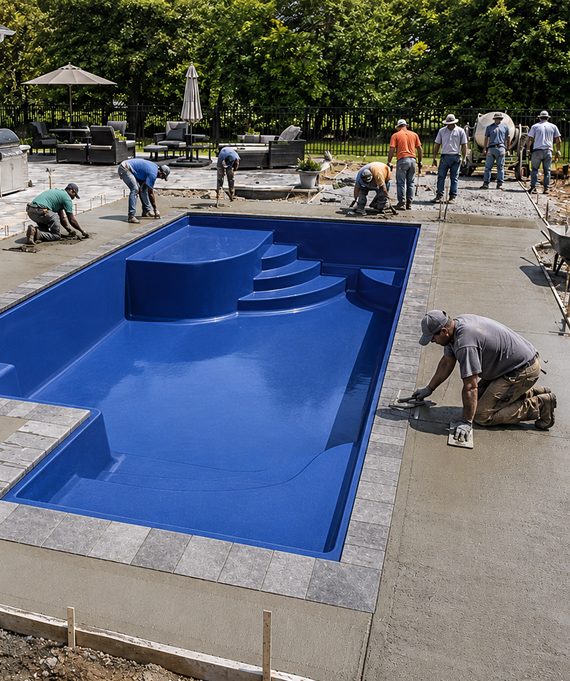
What matters more is what follows: water goes in and backfill goes around at the same rate, so the pressure stays balanced on both sides of the wall. Get that wrong and you can deflect a wall on the first day. Plumbing is tied in, the equipment pad is set, and the deck follows once everything has settled.

From order to swim
- Site evaluation and permits — two to six weeks, and the step most likely to slip.
- Shell production and cure — two to eight weeks depending on width.
- Excavation and set — one to two days.
- Plumbing, backfill and first fill — three to five days.
- Decking, landscaping and start-up — one to three weeks.
Most projects land between eight and twelve weeks from signed order to first swim, with permits and weather accounting for nearly all of the variation.
Where to go next
If you are still choosing a shape, the buying guides compare the trade-offs between freeform, rectangle and spa-combination layouts. If you have a shape in mind, a local certified dealer can tell you within a visit whether your access will take a crane.